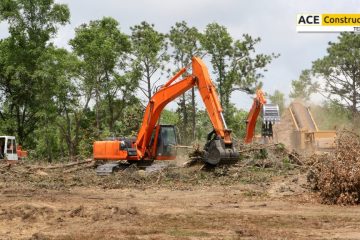
Finding the right excavating contractor in Austin takes more than comparing prices. Excavation and dirt work costs in Central Texas vary significantly based on site conditions, which can only be assessed during a site visit. The contractor who gives you the lowest phone quote and the contractor who gives you the most accurate scope are often different people. This guide covers what to look for, what to ask, and what a complete excavation estimate should include.
Ace Construction Company Austin handles residential and commercial excavation and dirt work throughout Austin and the surrounding metro. We’ve seen both categories of contractor outcome: projects done correctly that last for decades, and projects done with shortcuts that require expensive correction. The difference is usually visible in the estimate before the work ever starts.
Start With a Site Visit Requirement
The first thing to look for in an excavating contractor is whether they require a site visit before providing a final estimate. Austin’s soil and terrain conditions vary enough between properties that accurate numbers can’t be produced without seeing the ground. In western Austin, a site that looks like a simple flat pad from the street may have limestone 12 inches below grade, requiring breaking equipment and significantly changing the project scope. In eastern Austin, access constraints for equipment, existing tree root systems, and drainage conditions all affect the cost.
A contractor who quotes over the phone is skipping the assessment step that produces accurate estimates. Those quotes frequently change after work begins, either through change orders or through shortcuts taken to stay within the original number. Neither outcome serves you. Require a site visit before committing to any contractor.
What a Complete Excavation Estimate Should Include
| What to Look For | What to Ask If Not Included |
| Equipment mobilization and setup | Is mobilization included in the project total or billed separately? |
| Excavation to the specified depth | What depth is the estimate based on? What happens if a rock is encountered? |
| Base material specification | How much base material is included? How many compaction lifts? |
| Haul-off or on-site material management | Is haul-off included? What volume estimate is this based on? |
| Drainage slope establishment and verification | How is the drainage slope verified before forming begins? |
| Utility locate confirmation | Who is responsible for 811 locates and private utility locates? |
| Permit coordination | Who handles permits if required? Is that cost included in the estimate? |
| Rock breaking contingency (western Austin) | What is the plan and cost if rock is encountered during excavation? |
Understanding Austin’s Two Ground Conditions
Austin excavating contractors work in two distinct ground conditions that affect the scope and cost. East of the Balcones Escarpment, in Pflugerville, Hutto, Manor, and the flat eastern suburbs, excavation is in deep clay soil. Clay cuts cleanly, doesn’t require breaking equipment, and compacts well when moisture conditions are right.
West of the escarpment, in Lakeway, Bee Cave, Cedar Park, and the hill country transition, limestone begins at 12 to 18 inches below grade on many properties. Excavating in limestone requires hydraulic breaking attachments and significantly more time than in clay. An estimate for western Austin excavation that doesn’t account for the likelihood of rock isn’t accurate for that location.
When we estimate projects in Lakeway and the western areas, we assess surface exposures, visible caliche layers, and the excavation history of adjacent properties to gauge the likelihood of rock. We include rock breaking in the estimate when indicators suggest it’s probable, rather than treating it as a scope exception that adds cost mid-project.
Insurance and Permit Partners
Every contractor working on your property should be fully insured. Insurance protects your property and the crew in the event of damage or injury during the project. Ask for a certificate of insurance before any work begins and confirm that coverage is current.
Permits for excavation and dirt work in Austin depend on the scope of work. Projects disturbing more than one acre require a TCEQ Stormwater Construction General Permit. Projects near Heritage Trees within the Austin city limits may require review. We work with third-party permit partners who are familiar with Austin Development Services and TCEQ processes, and we factor permit timelines into project scheduling from the start.
What Matters Most in the Base Preparation Scope
For any excavation project that results in concrete flatwork, the most important detail in the estimate is the base preparation specification. This is the step that produces concrete that lasts in Austin’s clay soil or fails within a few years. The correct specification is a minimum of 4 inches of crushed limestone base, placed in two compacted lifts, with drainage slope verified before forming.
An estimate that specifies base preparation correctly is more likely to produce a correctly prepared site. An estimate that doesn’t mention base preparation, or that lists a single number without any specification of lift sequence or verification, may be planning to skip steps. Ask specifically: what base material, how many inches, how many lifts, and how the slope is verified before forming.
Getting a Site Visit From Ace Construction Company Austin
We require a site visit before providing a final estimate for any excavating contractor scope, any site preparation scope, or any project that includes base preparation and concrete. The site visit lets us assess soil conditions, rock likelihood, access, drainage, and utility considerations before giving you a number that reflects what your project actually needs. Call 512-265-1198 or request an estimate.