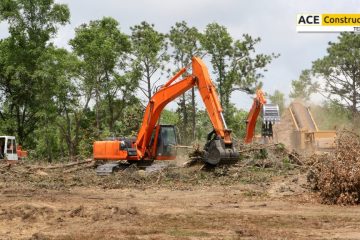
After a land clearing project is complete, the decisions made in the first few days determine how the site holds up until the next phase of work begins. Exposed clay soil in Austin is vulnerable to erosion. Cleared root systems will attempt to resprout. And the sequence of next steps, whether that’s grading, concrete, landscaping, or agricultural use, shapes how quickly those first decisions need to happen.
Ace Construction Company Austin handles land clearing as the first phase in a site development sequence, not as an isolated scope. We think about what comes next before we finish the clearing, because the two phases need to work together. This guide covers what to prioritize after clearing in Austin, how to manage the cleared site, and when to move into the next phase.
Priority 1: Erosion Control on Exposed Soil
Freshly cleared soil in Austin is bare clay. Clay without vegetation is vulnerable to sheet erosion during rain events. A cleared site without erosion control can lose significant topsoil in a single storm, with the material ending up on neighboring properties or in drainage channels, creating compliance problems.
The standard immediate measures after clearing are silt fence installation along the downhill perimeter of the cleared area, erosion control matting on slopes steeper than 3:1, and temporary seeding or mulch on areas that won’t be disturbed for more than 30 days. For projects requiring a TCEQ Stormwater Construction General Permit, these measures are required documentation before any construction activity begins.
We install erosion control measures as part of our clearing scope on projects that trigger these requirements, and we discuss erosion management with every customer whose clearing project will leave the site exposed to rain before the next construction phase.
Priority 2: Rough Grading Before Rain Hits
After clearing, the next earthwork step is rough grading to establish the building pad elevation and drainage direction. Grading before any significant rain events prevents low spots from collecting and holding water, which can saturate clay soil and delay the next phases.
On flat eastern Austin properties in Pflugerville, Hutto, and Manor, establishing a drainage slope requires active grading. Natural grade on these flat sites doesn’t reliably direct water away from future structures. We establish grade after clearing, while the cleared ground is accessible for equipment, and before rain events create wet conditions that delay compaction.
What Happens to Cedar and Brush After Clearing
Cedar is the most common clearing scope in Central Texas, and it’s also the most persistent. Cedar trees cleared to ground level will attempt to resprout from their root systems within the first growing season. The intensity of resprouting depends on when in the year the clearing was done and how much energy reserve the root system had at the time.
Cedar cleared in late spring through summer, after the main growth flush, has depleted more energy from the root system and typically resprouts less aggressively than cedar cleared in winter. For rural acreage where managing resprouts is a long-term priority, we can discuss herbicide application timing and follow-up cutting sequences as part of a brush management plan.
For residential and development clearing where the cleared area will be developed within one growing season, resprout management is usually not a significant concern because construction activity will continue to disturb the cleared area.
Moving Into the Site Preparation Phase
For most Austin development projects, site preparation follows immediately after clearing. The site preparation sequence covers organic stripping in the building footprint, base material placement and compaction, drainage slope establishment, and utility coordination before any concrete is poured.
Clearing and site preparation are often combined into a single mobilization for efficiency. Equipment is on site for clearing, and after clearing is complete, the same equipment proceeds into stripping and rough grading. Separating the scopes into two separate mobilizations adds cost without adding value for most residential projects. We typically sequence the two phases into one continuous scope when the project allows.
Landscaping After Clearing: Timing and Options
For properties being cleared for landscaping improvement rather than construction, the timing of vegetation establishment matters. Austin’s primary growing seasons are spring and fall. Seeding or planting in late February through April gives new vegetation a full growing season before summer heat. Fall planting from September through October gives roots a chance to establish before winter.
Native grass mixes suited to Austin’s clay soil establish well through hydroseeding. Native plant species adapted to Central Texas conditions have better survival rates in Austin’s climate than non-native ornamentals. We can discuss ground cover options for the cleared area during the clearing project.
For a clearing and landscaping sequence, or any clearing project leading into concrete driveways or other flatwork, call 512-265-1198 or request an estimate. We serve Buda, Kyle, Lakeway, and all of Central Texas.